All workPROJECT NOTES / 2026
COMPUTER VISION / RESEARCH

TCVM-Net

Verify what a single frame cannot tell you.

MY CONTRIBUTION
Solo build / computer vision & experimental evaluation
PROJECT SCOPE
Research implementation / controlled evaluation
TOOLS & TECHNOLOGIES
Python / PyTorch / YOLOv8 / OpenCV
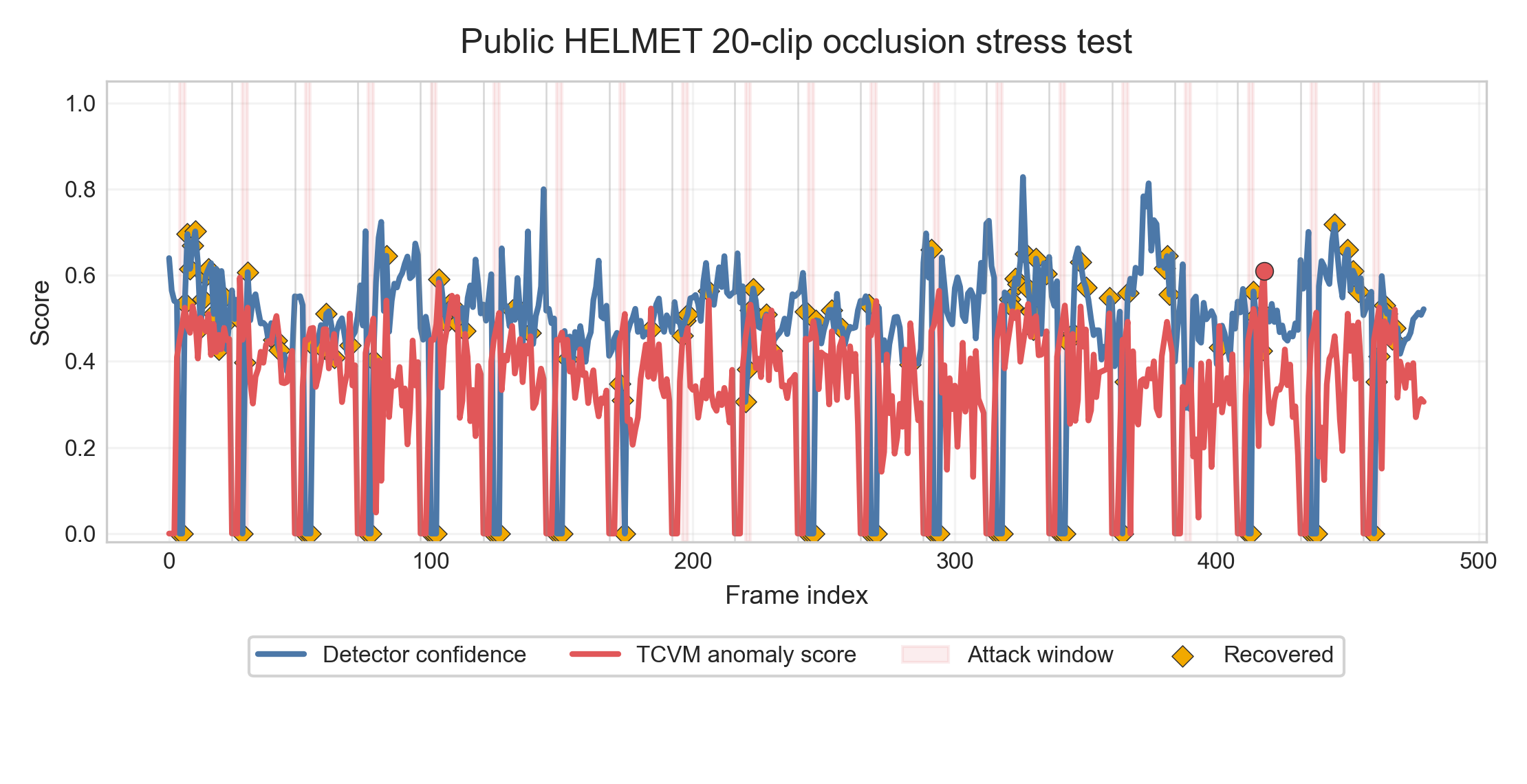
TCVM-Net experimental plot of temporal confidence under an occlusion stress test. Inspect original image
Original experimental figure / 20-clip study
01 / THE CONTEXT

The problem.

TCVM-Net adds temporal verification to traffic-surveillance object detection. A YOLOv8 detector and ByteTrack-style association feed a causal verifier that examines confidence stability, motion continuity, appearance similarity, sudden detection-count changes, and short gaps across frames.

The challenge

A detector can lose confidence during occlusion or visual perturbation even when the same object remains in the scene. Temporal recovery needs to use the sequence without turning every irregularity into an alarm or carrying stale detections forward indefinitely.

WHAT I WORKED ON

I built TCVM-Net solo: the detection and association pipeline, causal temporal verifier, perturbation experiments, calibration protocol, and evaluation figures. I designed the comparisons around recovery, false alarms, and the limitations of controlled tests.
02 / ENGINEERING DECISIONS

The decisions.

Verify the sequence around the detector

The verifier combines several temporal signals instead of relying on a single-frame confidence score. It wraps detection and association, which allows comparison with image-only, tracker-only, reference-frame, and temporal-verification baselines.

Keep calibration separate from evaluation

The documented 30-clip protocol selects a threshold using ten calibration clips and freezes it for twenty held-out clips. Splitting by source video keeps adjacent frames from the same clip out of both groups.

Measure recovery alongside false alarms

The experiment pipeline reports detection quality, anomaly recall and false-positive rate, as well as latency and memory. Threshold sweeps and ablations expose the cost of temporal verification instead of treating a recovered detection as sufficient evidence on its own.

Keep physical-style tests distinct from field validation

Occlusion and detector-specific patch experiments use synthetic overlays on real video frames. This supports a controlled comparison, while leaving printed physical attacks and real deployment conditions outside the demonstrated result.

03 / WORKFLOW

How it works.

  1. Prepare separate video clips

    Split by source clip and generate perturbations after the split, keeping calibration and test sequences separate.

  2. Detect and associate objects

    Run YOLOv8 and associate detections across frames before applying the temporal checks.

  3. Check temporal consistency

    Combine confidence, motion, appearance, count changes, and short-gap recovery into the verification process.

  4. Evaluate the operating point

    Freeze the calibrated threshold, compare held-out results and baselines, and retain the resulting summaries and figures.

05 / RESULTS & SCOPE

Results and scope.

0.887

Held-out anomaly F1 · repository result

0.021

Held-out false-positive rate · repository result

These repository-reported results belong to the calibrated 30-clip HELMET protocol: ten clips for calibration and twenty held out. The displayed temporal-confidence figure comes from the separate 20-clip occlusion study. Both concern controlled evaluation, not measured field performance.

Scope & limitations

Persistent, temporally smooth adaptive patches remain a documented failure mode; this is not a certified defense. Datasets, checkpoints, raw videos, and complete training runs are excluded from the repository, so reproduction requires those inputs separately. The citation metadata is provisional and does not establish conference acceptance.

KEEP EXPLORINGCVE Twin

SECURITY / AGENTIC AI