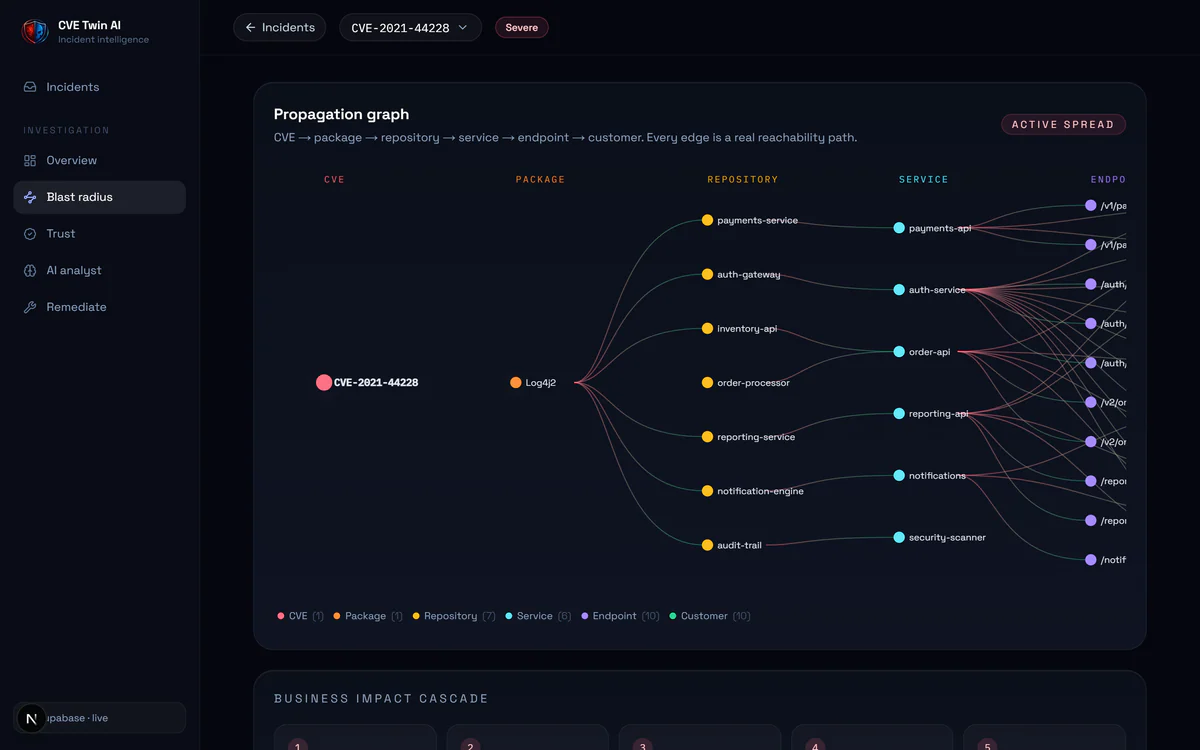
CVE Twin
Repair a vulnerability without breaking the services that depend on it.
Read case studyWatch walkthroughI build across the stack.
Then look for the places it can break.
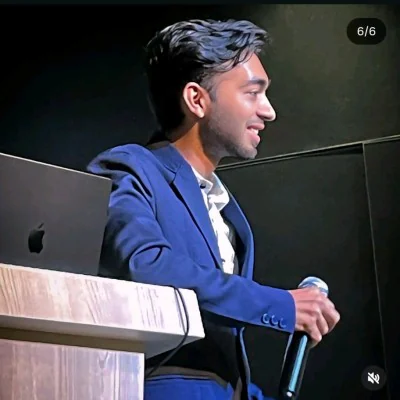 Computer Science, MIT Bengaluru
A spatial interpretation of CVE Twin: one vulnerable dependency, the services around it, and the evidence needed to repair it.
Spatial illustration of a controlled local demo. The hosted explorer does not execute repairs.
Real interfaces. Open implementation.
The problem, the decisions, and the evidence behind each build.
Repair a vulnerability without breaking the services that depend on it.
Read case studyWatch walkthrough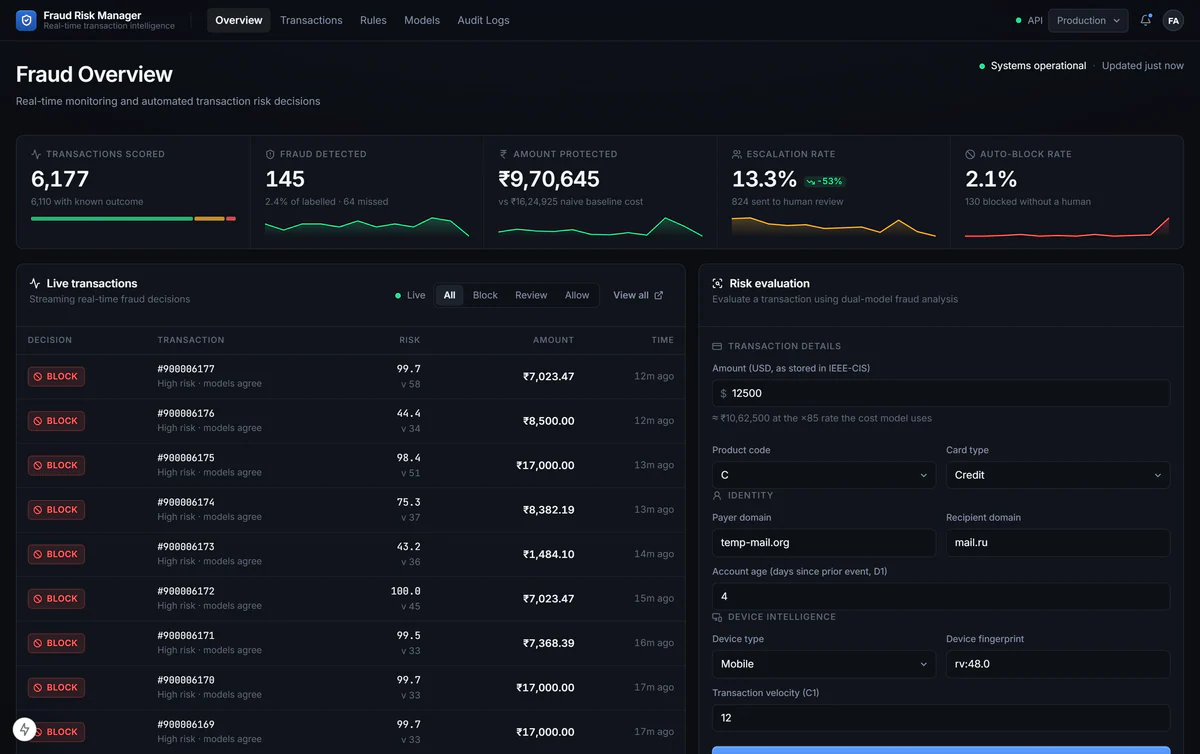
Turn fraud scores into explainable decisions within a review budget.
Read case studyWatch walkthrough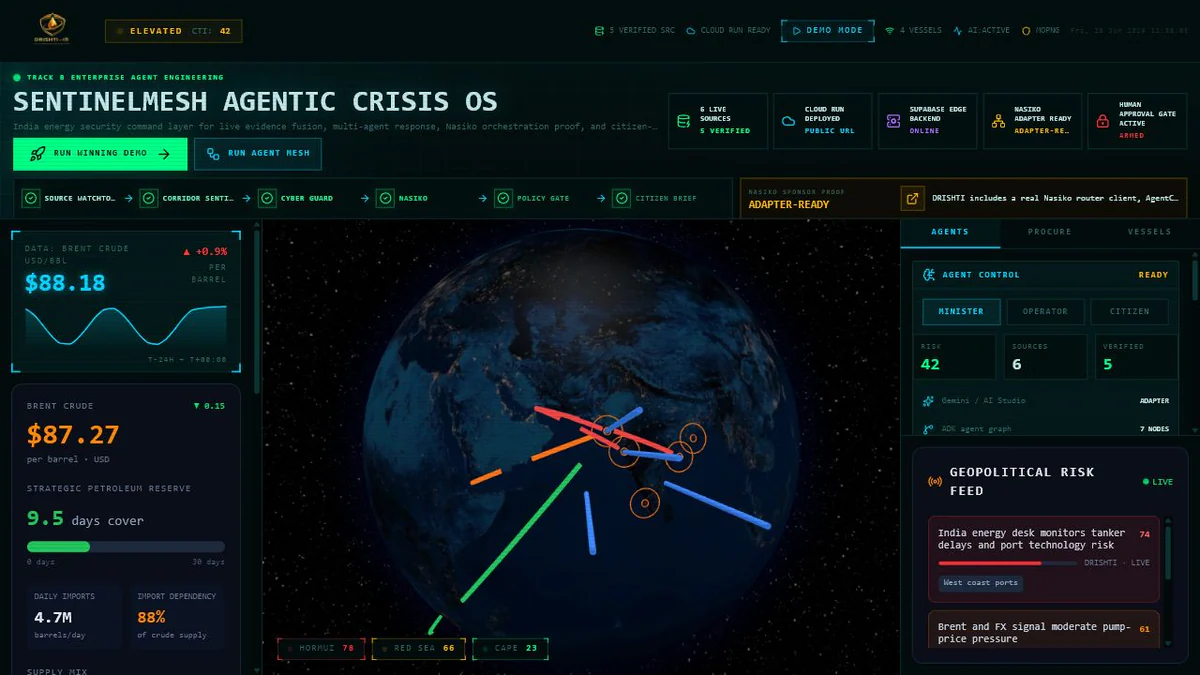
Bring crisis signals together before a human makes the call.
Read project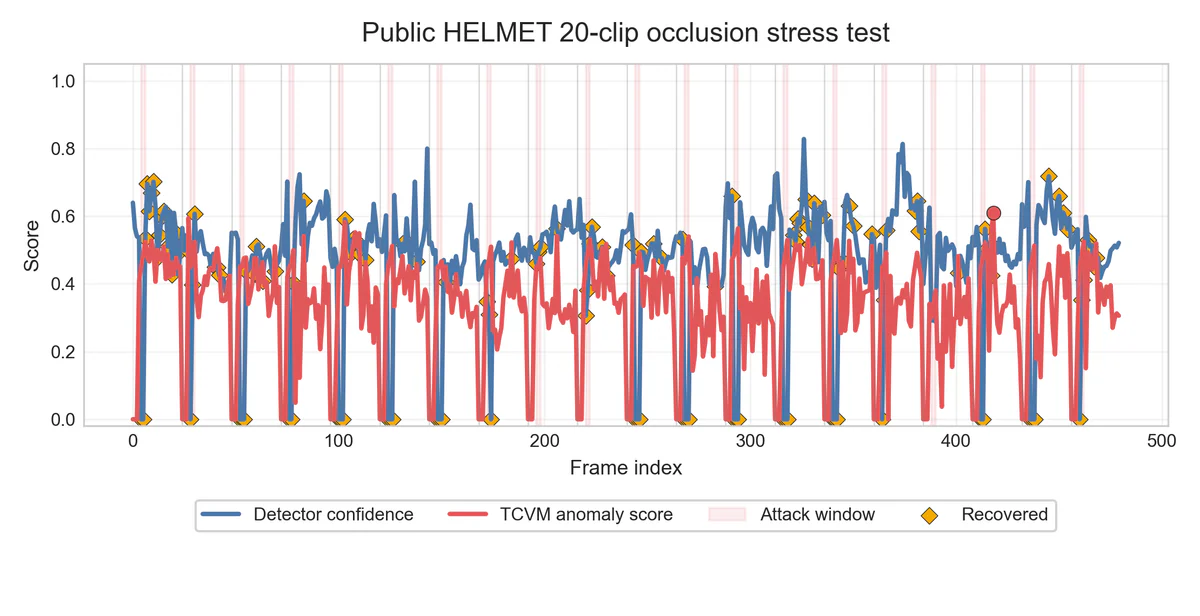
Check whether traffic-vision predictions stay consistent through interruptions.
Read projectFollow a repair from a failing baseline to a change that passes the same checks.
This silent clip records one local demonstration. The three-strategy comparison is documented separately in the case study.
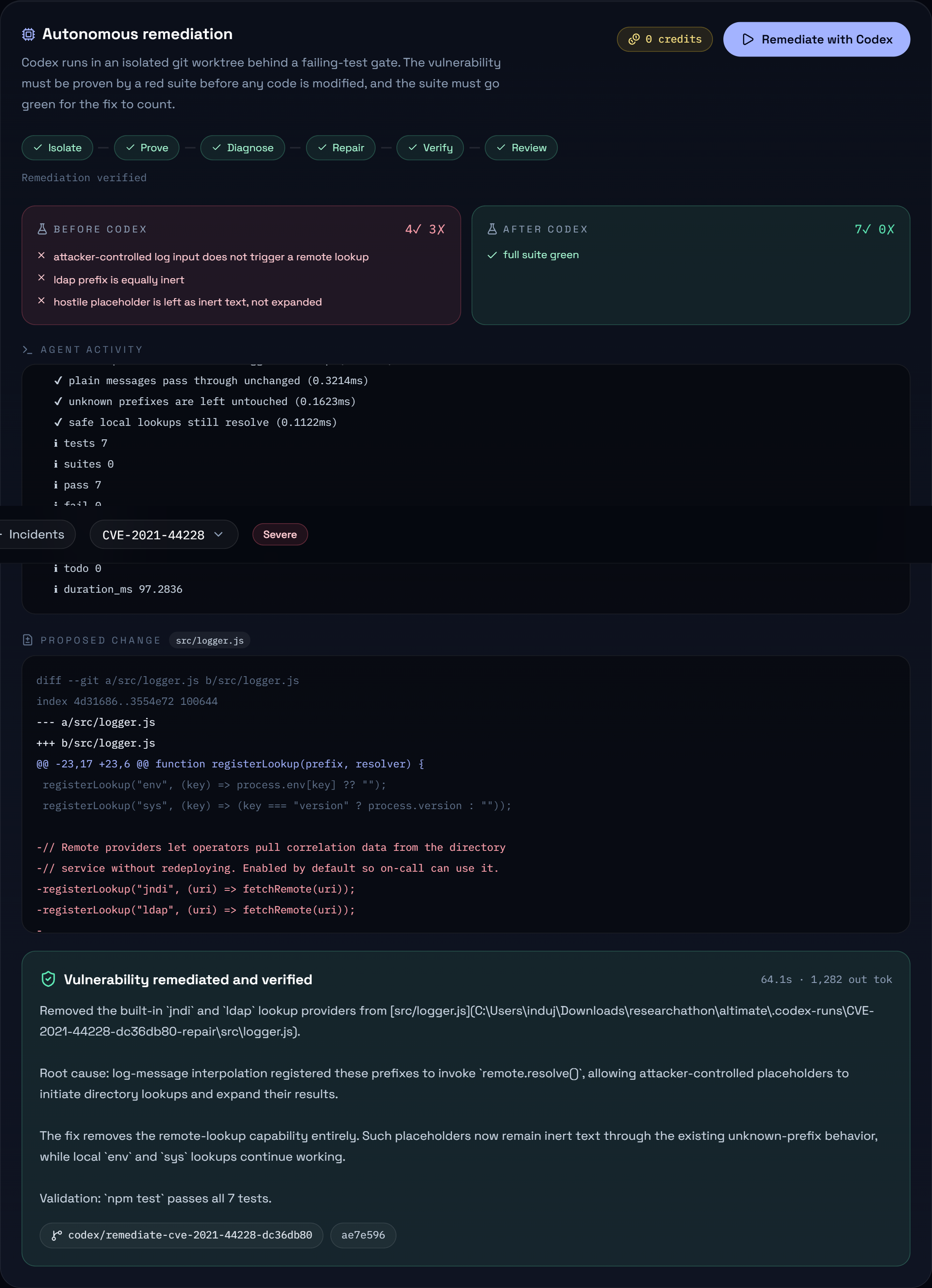
Before changing code, the local workflow demonstrates the vulnerability. The recorded baseline has four passing tests and three failing security checks.
The left-hand baseline panel identifies the three failing checks. A suite that was already green would not establish a repair.
A controlled fixture models the Log4Shell vulnerability class. All three recorded repair candidates were viable; the smallest change was selected. The hosted explorer cannot run the local repair engine.
Read the full caseBefore changing code, the local workflow demonstrates the vulnerability. The recorded baseline has four passing tests and three failing security checks.
Recorded result / read the BEFORE CODEX panelMinimal change, parser hardening, and a provider allow-list run in isolated worktrees. Each faces the exploit, security tests, and dependent-service contracts. All three were viable in the recorded comparison.
Actual investigation interface / comparison results are in the linked runThe recorded selection is the minimal repair. The security suite finishes with seven passes and no failures, while the result keeps the diff, branch, commit, and verification evidence available for review.
Recorded result / read AFTER CODEX and the proposed changeSee how model assessments become an explainable decision—and when that decision needs a person.
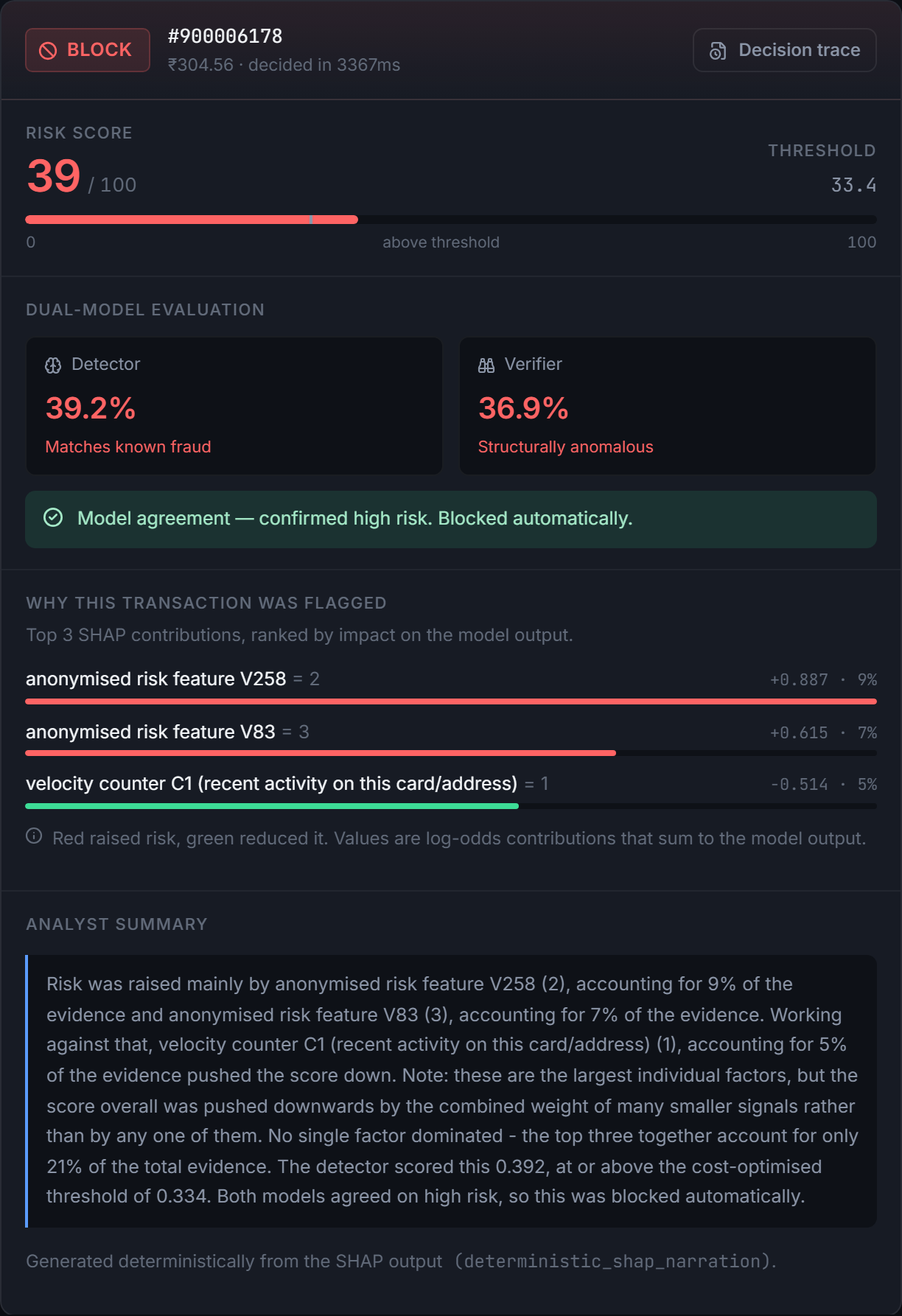
XGBoost looks for learned fraud patterns; an Isolation Forest verifier assesses unusual structure. The captured example shows detector and verifier scores alongside the features contributing to the decision.
Read DUAL-MODEL EVALUATION, then the SHAP contributions below it. These scores describe this captured example; they are not calibrated probabilities.
The 40.6% result compares the capacity-capped detector with an amount-threshold baseline on an IEEE-CIS temporal holdout. It uses modeled costs, not production savings. The review branch here illustrates the policy; it is not a new scored transaction.
Read the full caseXGBoost looks for learned fraud patterns; an Isolation Forest verifier assesses unusual structure. The captured example shows detector and verifier scores alongside the features contributing to the decision.
Actual interface capture / transaction #900006178 was blockedBoth high-risk assessments produce a block; both low-risk assessments permit an allow. The actual trace shown here records agreement on high risk, followed by BLOCK and an audit-log entry.
Actual decision trace / the recorded action is BLOCKIf the assessments disagree, the policy holds the transaction for a human instead of choosing one model. This step illustrates that branch using the real operations interface; it is not a replay of the blocked transaction above.
Actual operations interface / disagreement branch is illustrativeFollow the agent workflow or the temporal-vision pipeline, then inspect the original evidence.
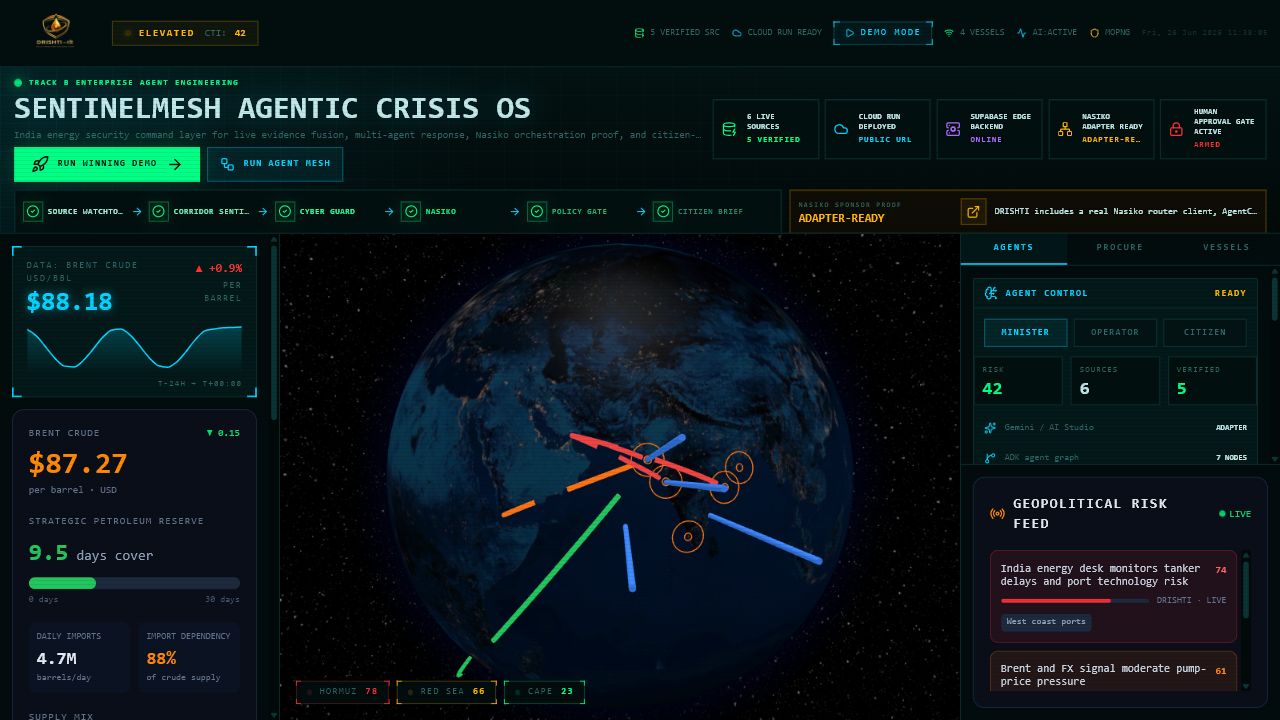
A crisis-intelligence command center connecting maritime, cyber, market, weather, and news signals. Specialist agents assemble evidence while consequential decisions stay behind human approval.
Read projectCollect the available public maritime, market, weather, news, and cyber signals, with fallbacks for unavailable sources.
Documented agent workflow · The screenshot shows the interface in demo mode.
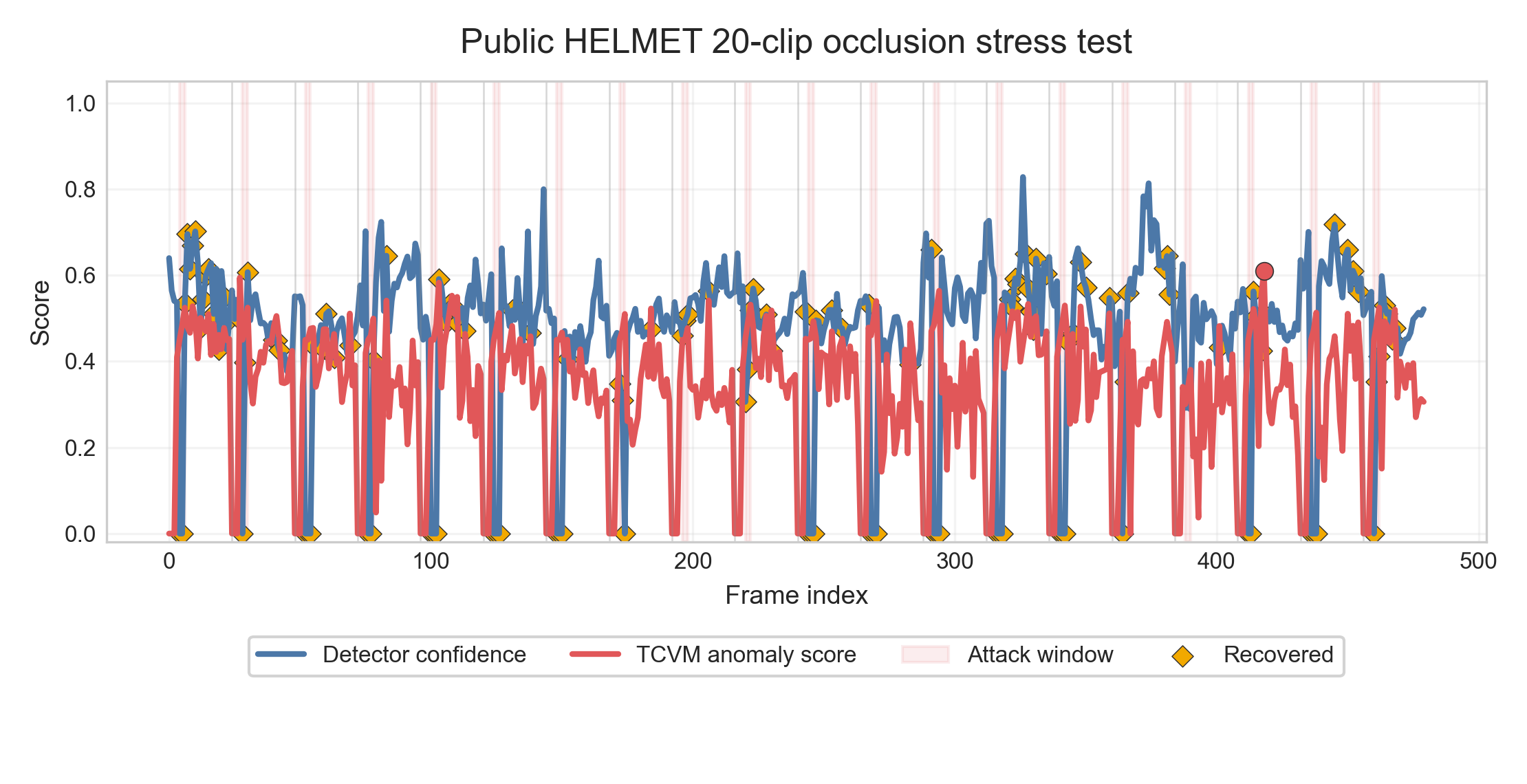
Temporal verification for traffic vision: confidence stability, motion continuity, and short-gap recovery. The public experiments examine behavior under controlled perturbations, including a 20-clip occlusion stress test.
Read projectSplit by source clip and generate perturbations after the split, keeping calibration and test sequences separate.
The figure above comes from the separate 20-clip occlusion study. This guide describes the documented implementation and evaluation workflow.
Product engineering, security, and the systems behind an interface.
Read the résuméSoftware Engineering Intern
Bengaluru, IndiaContributed to product development at Turbostart as a Software Engineering Intern, collaborating with the engineering team.
Software Engineering & AI Development
Bengaluru, IndiaIncluding Confab 360 Degree and MentorEdge
Full-stack and AI development across Prizlyn, Confab, and MentorEdge. Developed React, TypeScript, and Node.js features across three major product releases and built GitHub Actions pipelines that reduced build-and-deploy time by 30%.
Cybersecurity Intern
Lucknow, IndiaEngineered AI helmet and seatbelt detection with PyTorch and OpenCV. Conducted penetration testing with Burp Suite, Nmap, and Metasploit, identifying 12+ critical vulnerabilities and reducing incident response time by 60%.
Software Development Engineer Intern
RemoteBuilt RESTful APIs and React and TypeScript frontend components. Asynchronous processing optimizations reduced ML pipeline latency by 35% and increased user engagement by 25%.
Full Stack Engineer · Contract
RemoteOwned REST API development for 500+ enterprise clients. Implemented JWT and OAuth 2.0 and optimized PostgreSQL and MongoDB queries for 40% faster data retrieval.
Career outcomes from my résumé. Explore project evidence
Exploring the tradeoffs between intelligence, explainability and the resources a system actually has.
Can reinforcement learning schedule bursty quantum-key-distribution workloads without overloading edge nodes? Co-authored a D3QN-PER study evaluated in a three-node simulation, with five-seed validation against Round-Robin and Least-Loaded baselines. Published at IEEE COMSNETS; the evidence concerns simulated scheduling workloads.
Can transformer networks learn the probabilities of quantum measurement outcomes? Explores that question using Qiskit-generated simulations. The work concerns learning from simulated quantum systems; it does not establish performance on physical quantum hardware.
How can document summarisation and question answering run on CPU-only machines while remaining explainable? Co-authored a transformer pipeline focused on resource-constrained deployment. Accepted at AICCoNS 2026; the linked co-author announcement establishes the scope and acceptance, without reporting a deployment benchmark.
How should an air-quality model balance prediction quality, computational cost, and an explanation people can inspect? Co-authored the Carbon-Aware Consensus framework to study those tradeoffs. Accepted at IEEE CONECCT 2026; the linked announcement does not establish a deployed monitoring system.
I build across the stack, and think about the whole system.
Full-stack engineering for AI and security products, from API design and model integration to interfaces that make complex decisions inspectable. My work spans developer tooling, applied machine learning, product interfaces, and the boundaries that keep a system secure.
I’m studying Computer Science at MIT Bengaluru, graduating in 2027. Since August 2025, I have led SDG Club: a 50-member team whose initiatives have reached 500+ students, creating opportunities to build, share, and learn.
The complete résuméInterfaces, APIs, and the systems connecting them.
Authentication, threat modeling, and hands-on security.
Applied computer vision and quantum computing research.
Cloud tooling, delivery pipelines, and Web3.
Manipal Institute of Technology, Bengaluru
Data Structures & Algorithms · Computer Networks · Operating Systems · Cryptography · Machine Learning · Distributed Systems
University of Illinois Urbana-Champaign
Credential 40K83BGOCR8ZHackathons are where I test ideas under pressure, learn from collaborators, and turn a problem statement into something working.
Organizing, sharing what I learn,
and representing the communities I’m part of.
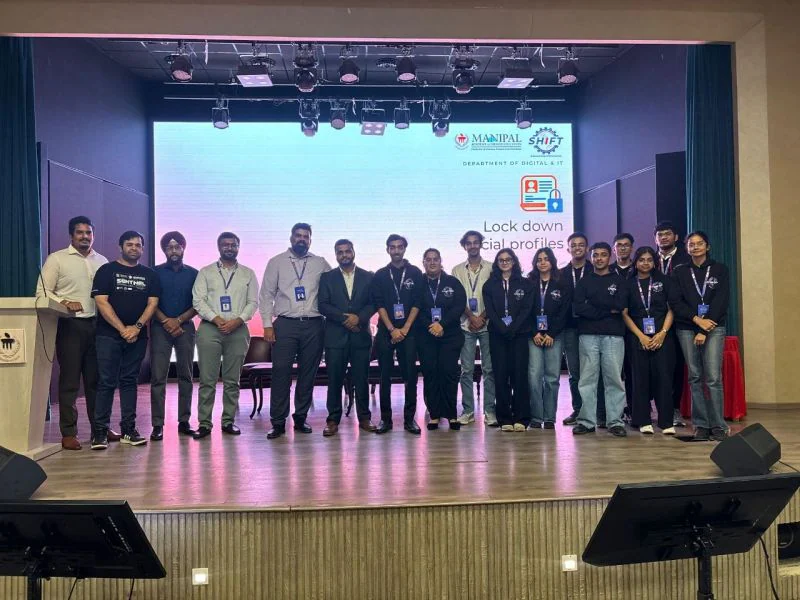
Helped organize CryptNite at MIT Bengaluru, building and deploying CTF infrastructure for national qualifiers and on-campus finals.
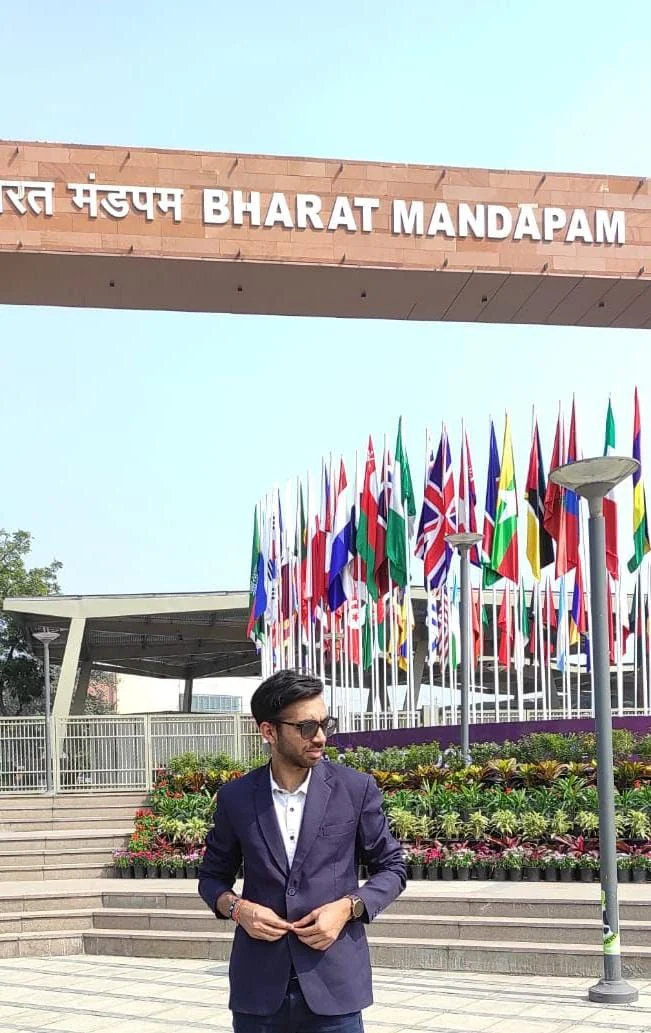
Selected to represent MAHE Bengaluru at the OpenAI Town Hall at IIT Delhi and the India AI Impact Summit 2026 in New Delhi.
Read the story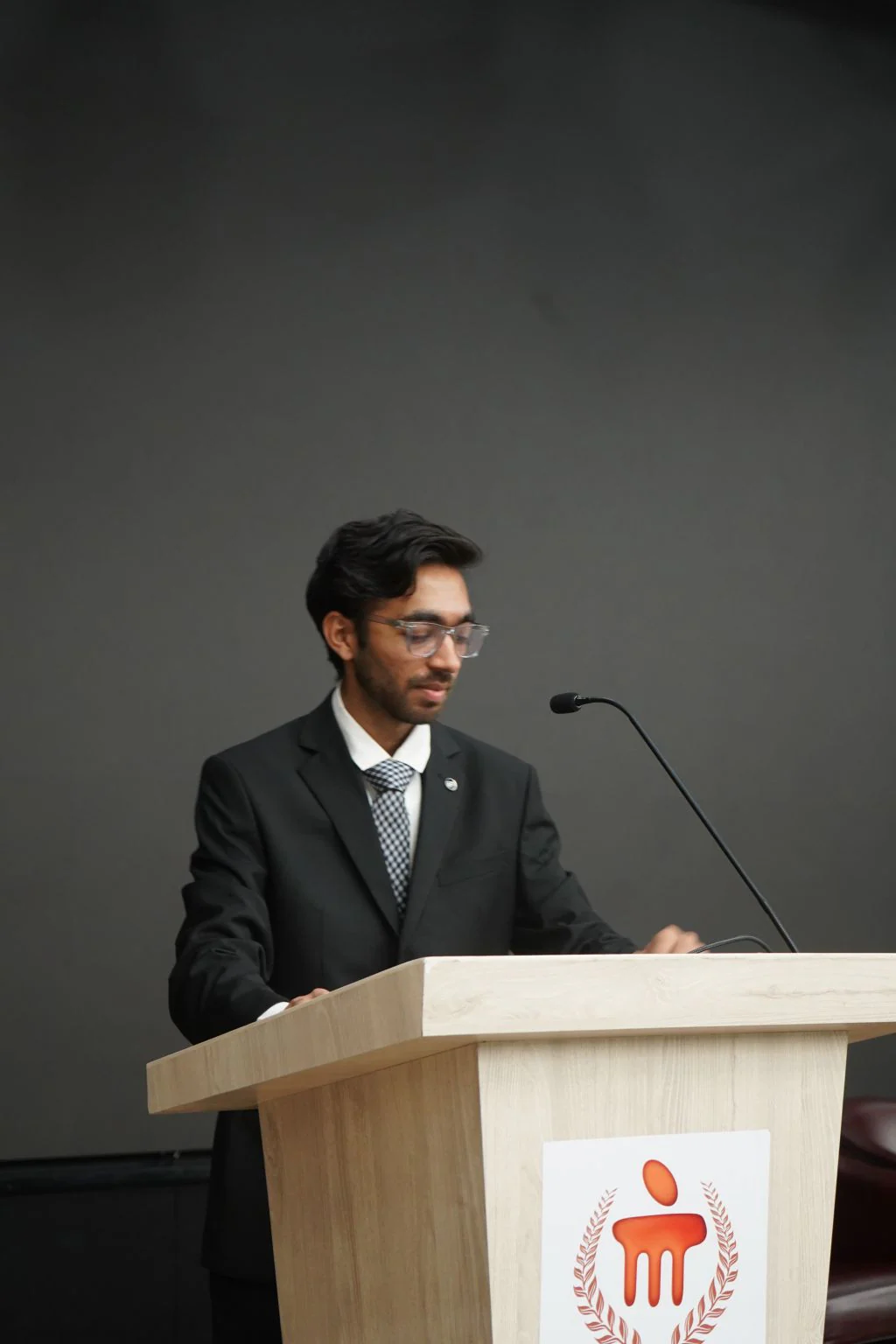
As President of SDG Club at MIT Bengaluru, I led our flagship hackathon with Honeywell Aerospace Technologies. Our core committee and volunteers brought 70 shortlisted teams together to tackle industry problem statements.
Spoke alongside Panchadip Bhattacharya about research publications, launching startups, and hackathon strategies. The two-day SDG Club initiative received 250+ registrations and brought teams together to ideate, prototype, and pitch.
Read the club recapPresented our work with Saaheer Purav, Ashmika Jain, and Riddhi Rajesh at a developer conference hosted by Sonar and DevRelSquad (by GoAvo.ai), at the Microsoft office. A chance to exchange ideas about AI-assisted development with fellow engineers.
Read my teammate’s accountThree small experiments in connection, interference, and signal. Change a parameter and see what happens.