All workPROJECT NOTES / 2026
MULTI-AGENT SYSTEMS

SentinelMesh

Turn scattered signals into a reviewable decision.

MY CONTRIBUTION
Solo build / full-stack engineering & agent orchestration
PROJECT SCOPE
Multi-agent prototype / demo-mode interface
TOOLS & TECHNOLOGIES
Next.js / Gemini / Three.js / Supabase
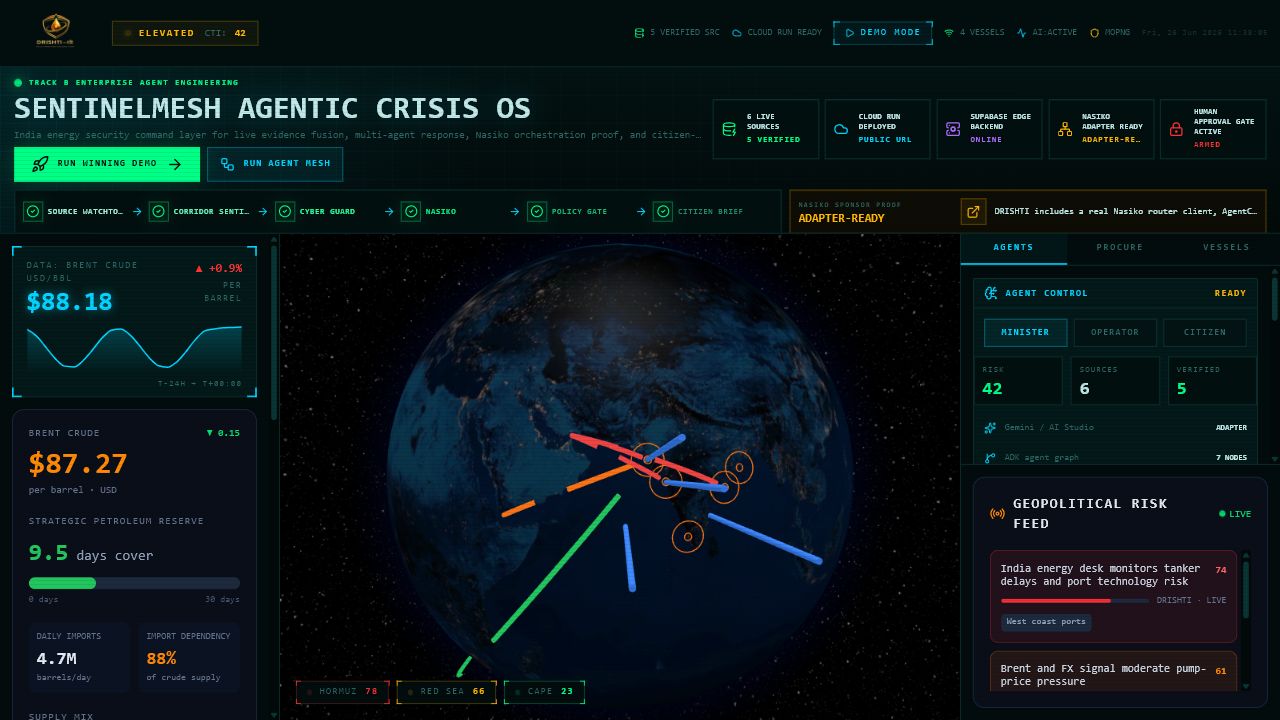
SentinelMesh command-center screenshot with a globe and intelligence panels in demo mode. Inspect original image
Actual interface / demo mode
01 / THE CONTEXT

The problem.

SentinelMesh brings maritime, energy-market, cyber, weather, and news signals into one crisis-intelligence interface. The public project connects a Next.js command center, Gemini-backed specialist agents, a Cloud Run gateway, and Supabase Edge services, with a separate citizen briefing view.

The challenge

Signals from a shipping corridor, port technology, and fuel markets arrive in different forms. The system needs to assemble their evidence, distinguish live information from fallback content, and give an operator a reviewable decision before turning it into public guidance.

WHAT I WORKED ON

I built SentinelMesh solo, from the Next.js operator interface and citizen briefing view to the specialist-agent workflow, deployment gateway, and Supabase integration. I defined the source/fallback boundaries and the human approval step for consequential actions.
02 / ENGINEERING DECISIONS

The decisions.

Give each stage a defined responsibility

Source Watchtower gathers evidence, Corridor Sentinel examines route exposure, and Cyber Guard assesses infrastructure risk. Policy Gate and Citizen Brief handle approval and communication. This separation makes the documented workflow easier to inspect than one undifferentiated model response.

Keep consequential action behind approval

The policy gate requires human review for market-moving decisions. The system can assemble evidence and draft guidance while keeping that decision boundary visible to the operator.

Connect the frontend through a deployment gateway

The documented architecture sends frontend API traffic through Cloud Run to Supabase Edge. Firebase uses method-preserving 307 redirects for those requests, so a POST keeps its method when reaching the gateway. Supabase can persist source snapshots, agent runs, and mission briefs.

Make fallback data part of the product scope

Public sources include energy references, weather information, and vulnerability intelligence. When fully open vessel data is insufficient, the demo uses simulated movement. That distinction matters when reading the globe and risk panels: a complete-looking interface is not proof that every displayed signal is live.

03 / WORKFLOW

How it works.

  1. Gather evidence

    Collect the available public maritime, market, weather, news, and cyber signals, with fallbacks for unavailable sources.

  2. Run specialist analysis

    Route the evidence through the documented corridor-risk and cyber-risk agent stages.

  3. Review the proposed action

    Apply the policy gate and require human approval for consequential decisions.

  4. Produce a briefing

    Present the reasoning to operators and translate it into the simpler citizen briefing interface.

05 / RESULTS & SCOPE

Results and scope.

The visual evidence is the repository-published dashboard in demo mode. It demonstrates the interface and agent workflow; it is not a record of an operational crisis response.

Scope & limitations

Some sources need credentials, exact cargo information is constrained by data access, and vessel movement can be simulated. The Nasiko integration is an adapter and registration path; the broader native orchestration features described in the roadmap are not all implemented. The app can run without database persistence, so an available interface alone does not establish a durable audit record.

KEEP EXPLORINGTCVM-Net

COMPUTER VISION / RESEARCH